1. Metal-Organic Frameworks in Catalysis
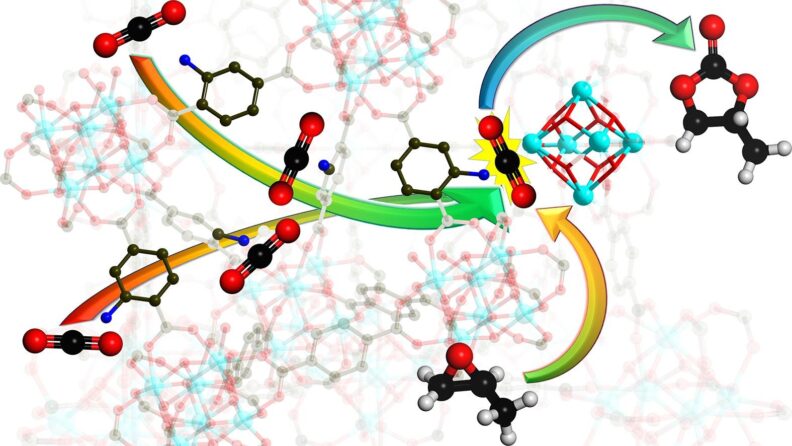
Metal–organic frameworks (MOFs) offer a uniquely powerful platform for heterogeneous catalysis, combining exceptionally high surface areas and tunable porosity with atomic‑level control over their metal nodes and organic linkers. Their modular construction allows precise installation of open metal sites, functional groups, and redox‑active centers, creating uniform catalytic pockets that bridge the gap between molecular and solid-state catalysts. Defect engineering further expands this versatility: introducing missing-linker or missing-cluster defects generates unsaturated metal sites, enhanced porosity, and new reaction pathways that can dramatically improve catalytic activity and selectivity. MOFs also accommodate multiple active components, such as nanoparticles or photosensitizers, enabling cooperative and cascade transformations within a single scaffold. Many modern MOFs, especially Zr‑, Ti‑, and Cr‑based systems, provide exceptional thermal and chemical stability along with easy recyclability and compatibility with post‑synthetic modification. In our group, we leverage these advantages through the design and study of defective MOF catalysts for challenging reactions, including carbon dioxide conversion, oxidative desulfurization, and other small molecule transformations, highlighting how defect‑tailored frameworks can address key energy and environmental problems.
2. Luminescent Metal-Organic Frameworks
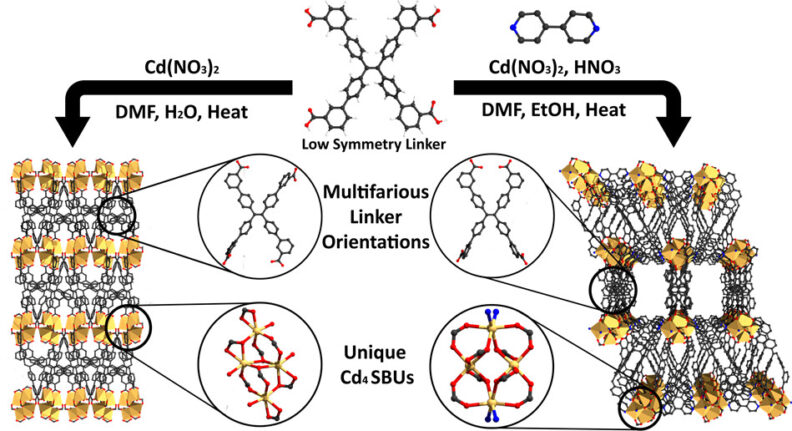
Luminescent metal–organic frameworks (LMOFs) represent a versatile platform for developing functional photonic materials with applications in sensing, imaging, and light‑emitting technologies. In our group, we focus on designing and synthesizing LMOFs that incorporate tetraphenylethene (TPE)‑based ligands, molecules known for their aggregation‑induced emission (AIE) behavior, which allows them to emit strongly when integrated into rigid MOF scaffolds. Embedding TPE units within ordered porous frameworks enhances their emission efficiency, enables precise control over chromophore orientation and spacing, and allows the photophysical response to be tuned through framework topology, defect engineering, and post‑synthetic modification. These materials offer high sensitivity to environmental stimuli, making them excellent candidates for chemical and biological sensing. Our research aims to understand and manipulate structure–property relationships in TPE‑based LMOFs, ultimately enabling new approaches to light‑responsive materials and responsive sensing technologies.
3. Metal-Organic Frameworks for Adsorption and Separation
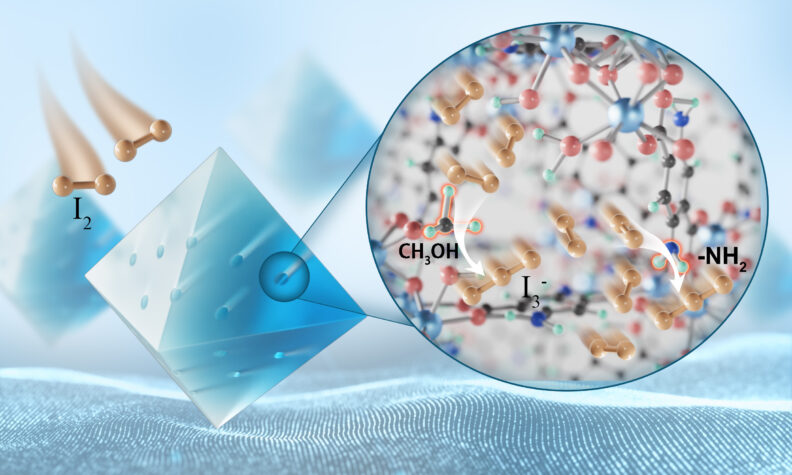
Metal–organic frameworks (MOFs) provide an exceptionally tunable platform for adsorption and separation, where their high porosity, adjustable pore chemistry, and structural precision enable selective capture of targeted species. In our group, we focus on designing MOFs for the adsorption and separation of iodine and lanthanides, two classes of materials that pose significant challenges in environmental remediation and resource recovery. The inherent modularity of MOFs allows us to tailor pore environments, introduce functional groups that enhance binding affinity, and leverage defect engineering to create highly accessible and reactive adsorption sites. For iodine capture, we explore frameworks that promote strong host–guest interactions through open metal sites, π‑donor linkers, and confinement effects that stabilize polyiodide species. For lanthanide separation, we utilize MOFs with precisely spaced coordination sites and tunable charge environments to achieve selective uptake based on ionic radius, coordination preferences, and ligand‑field effects. By integrating structural design, spectroscopy, and adsorption studies, our research seeks to advance MOF‑based solutions for complex separation challenges relevant to nuclear waste management, critical‑element recovery, and environmental sustainability.
4. Metal–Organic Frameworks in Nuclear Science
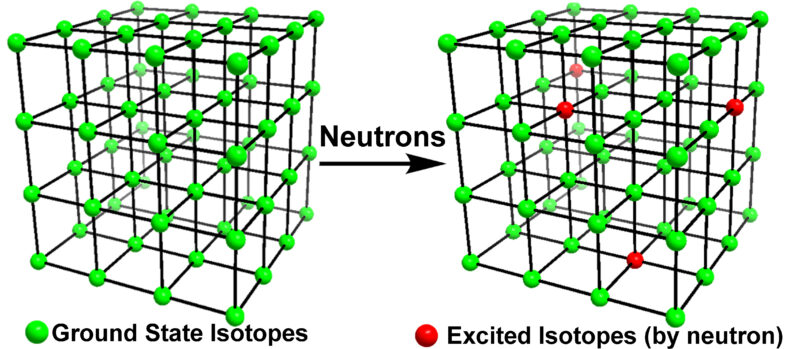
Metal–organic frameworks (MOFs) offer an extraordinary level of structural precision and functional tunability that makes them promising materials for advanced applications in nuclear chemistry. In our group, we explore how MOFs can be leveraged in neutron‑initiated transmutation, isotope production, and radionuclide adsorption and separation, areas traditionally dominated by inorganic solids and high‑temperature systems. The modular nature of MOFs enables the incorporation of neutron‑active elements directly into their nodes or linkers, allowing us to investigate how framework composition, defect sites, and local coordination environments influence neutron capture processes and subsequent transmutation pathways. Their high surface areas and accessible porosity also provide unique opportunities for efficient radionuclide adsorption, where tailored functional groups, redox‑active sites, and precisely spaced chelating environments enhance selectivity and capacity. Additionally, the crystalline order of MOFs enables fundamental mechanistic studies of radionuclide binding and transport, supporting rational design of materials for isotope enrichment, medical isotope production, and nuclear waste remediation. Through this work, we aim to establish MOFs as a new class of functional materials for nuclear science and technology.
5. Surface‑Engineered Oxides and Phosphates for Advanced Heterogeneous Catalysis
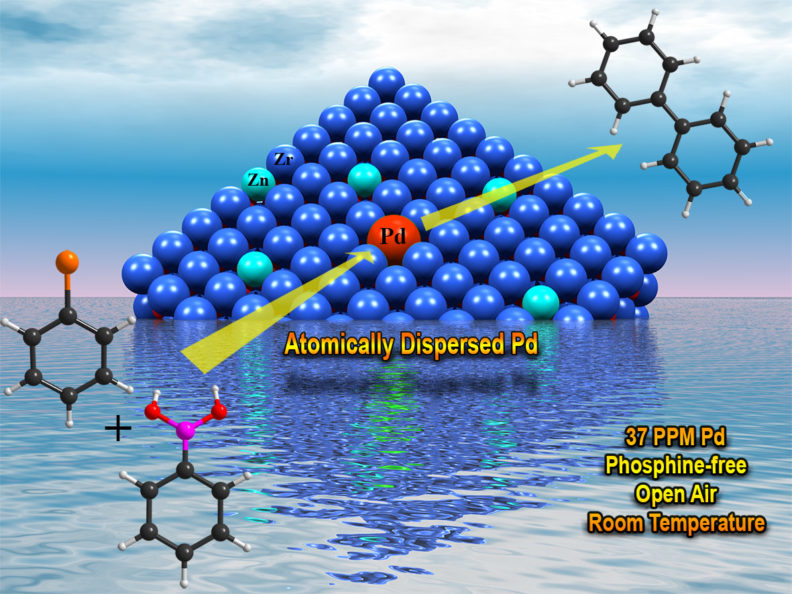
Metal oxides and layered inorganic materials offer robust, thermally stable platforms for creating highly dispersed catalytic sites, and our group explores this potential by using mixed metal oxides and zirconium phosphate as supports for single atoms and metal nanoparticles. These supports provide tunable surface acidity, redox character, and coordination environments that stabilize isolated metal centers and control nanoparticle nucleation and growth. By manipulating composition, defect concentrations, and surface functional groups, we design catalysts with precise active‑site architectures that enable efficient and selective transformations. Our catalytic studies focus on hydrogenation reactions, Suzuki cross‑coupling, and other small‑molecule conversions, where the combination of controlled dispersion and strong support–metal interactions enhances activity, stability, and resistance to sintering. Through this work, we aim to bridge inorganic materials chemistry with molecular‑level catalysis, developing next‑generation heterogeneous catalysts for sustainable and industrially relevant chemical transformations.