David Max Roundhill
1942–2024
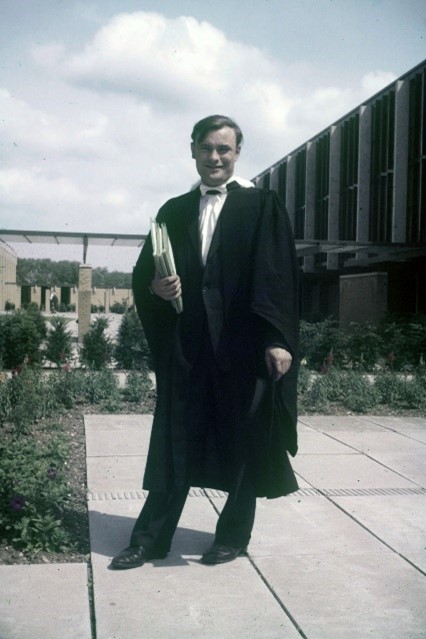
From 1968 until 1984, D. Max Roundhill was a beacon of inorganic chemistry at Washington State University. He joined WSU as a fresh assistant professor following a postdoctoral at Tulane. He rose through the ranks to full professor and along the way trained more than 14 PhD’s. During that period, he published about 65 of the more than 200 papers and three books he would eventually coauthor. Throughout that rise, he was always a friend to the graduate students on the first floor of Fulmer and Fulmer Annex (yes, even the physical chemists and chemical physicists). He and Ivan Legg could often be found with a group of graduate students drinking beer and (many) smoking at a local bar. Max was a first-rate chemist, a great mentor, and he was also a bit of a grumbler. I clearly remember a never-ending refrain about how Pullman was just too rural and how he wanted to move to a more urban environment.
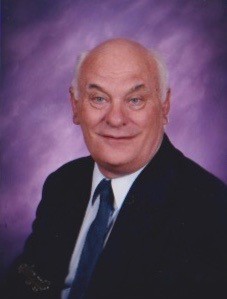
Though he was born in Oldham, England, during the second world war, he always considered himself a Yorkshire man. He did his undergraduate work at Oxford and his PhD (in two years) at the Imperial College of London. From this very urban background, he and his then new wife, Stephanie, moved to an equally urban Tulane to do his postdoctoral studies. You might imagine the shock of the transition to a 1968 Pullman.
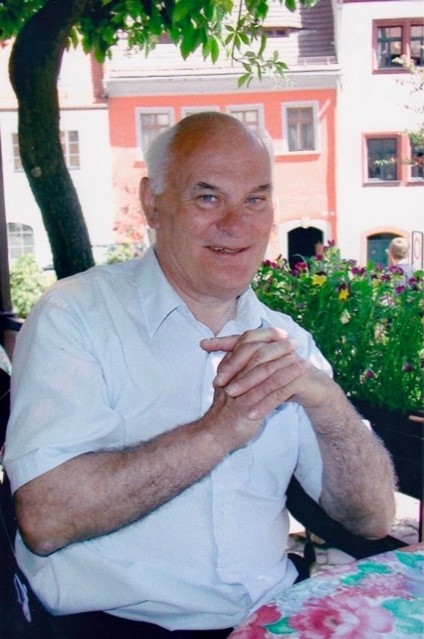
In 1985, he finally got his wish. He was hired as professor and chair of chemistry at Tulane. From there, he became chair of chemistry and biochemistry at Texas Tech University from 1996 to 1999 and then continued on the Texas Tech faculty until 2004 when he officially retired. But Max couldn’t really quit. From 2005 until his death, he was involved in various consulting activities—first in Austin Texas and later in Seattle.
Max and Stephanie loved to travel. They visited all seven continents and numerous countries.
In October of 2024, D. Max Roundhill passed away in Seattle, Washington. He leaves Stephanie, their three boys, and a large number of once-young scientists who will always remember how much he gave them. He lived a full and productive life, and I think God is pleased by how he spent his talents.
Kirk McMichael
1935–2025
When I think of Kirk McMichael, I think of classrooms full of undergrad organic chemistry students, and I think of bagpipes, and kilts. He projected this image for the 38 years he served WSU. Sadly, Kirk passed away in July 2025 just before his 90 birthday. Let me share a bit about him.

Kirk was born in Schenectady, NY, on July 13, 1935. He earned a BS from Shimer College at the tender age of 19 and then earned his PhD from the University of Chicago. He married Laura Lundorff (his lifetime partner) on June 21, 1958. Kirk then completed a postdoc in the town of Madison, Wisconsin. From there, he made his final move to Pullman, WA. He joined the WSU chemistry faculty in 1960 and was promoted to associate professor in 1968. From 1968 to 1986, he served as the assistant chair and then associate chair of chemistry. He went on a sabbatical at the University of Glasgow (Scotland, of course!) in 1975. From 1979 to 1980, Kirk served as the faculty council chair. In 1989, he won the Burlington Faculty Achievement award, and he was elected to the Fellowship of the American Association for the Advancement of Science in 1990. In 1997, he was recognized by the college for adapting graphical software for teaching organic chemistry. In 1999, the college awarded him the Faculty Advising Excellence Award for his role in advising undergraduates.
Kirk celebrated his Scottish heritage playing bagpipes as a member of the Border Highlanders for 40 years and served as the pipe major for a time. The band played for many community events, and Kirk played for weddings, funerals, and always for his classes on the last day of class. He performed in many special concerts, such as the Bryan Hall Brass and Pipe Organ performance featuring two WSU faculty ensembles: En Chamade and Equinox, both with Kirk on bagpipes.
So much for data. Kirk was a big, tall Scotsman who was the most loved of the chemistry faculty. He always had time for a kind word and a gentle nudge to put a confused student or an aggravated faculty member back on the right track. He was a wise gentleman, and we’ll miss him.
Sincerely,
K. W. Hipps
Regents Professor of Chemistry and of Materials Science and Engineering
Fellow of the ACS, APS, AVS, and AAAS
Chair of Chemistry, 2005–2015
Ralph G. Yount
1933–2025
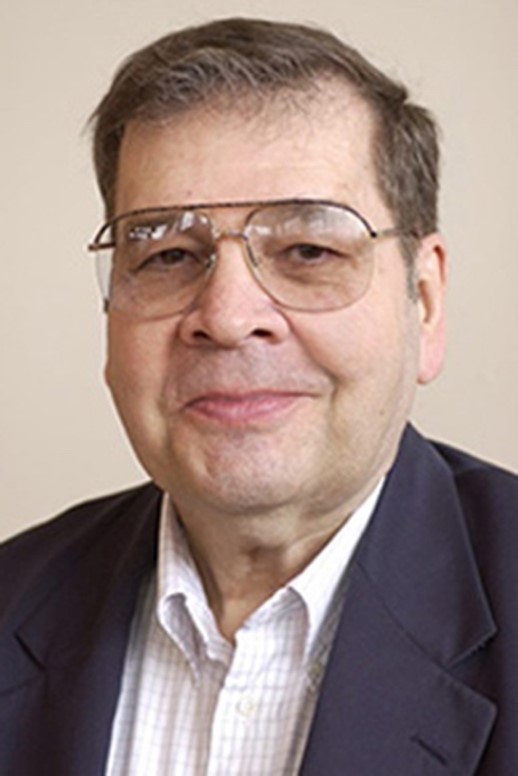
Ralph G. Yount passed away this past June at the age of 93. Ralph had a remarkable 44-year career at WSU, retiring in 2004. Ralph received his undergraduate degree in chemistry from Wabash College in Crawfordsville, IN, and went on to obtain his PhD in biochemistry/chemistry at Iowa State University where he worked under D.E. Metzler. He then did postdoctoral work with D. E. Koshland, Jr. at Brookhaven National Laboratory before starting his faculty career at WSU with joint appointments in both chemistry and agricultural chemistry (which later became the Institute of Biological Chemistry).
Ralph’s research focused on the molecular mechanism of muscle contraction and of motility in biological systems via synthesis and utilization of small molecules of biological interest, e.g., ATP analogs as they applied to muscle research. In particular, his work advanced medical understanding of diseases such as muscular dystrophy, ALS, and myasthenia gravis. The NIH funded his research continuously for 43 years, which was one of the longest continually funded programs at the NIH.
Ralph served as vice-president and was chairman of the postdoctoral fellowship committee for the Muscular Dystrophy Association for 15 years. He was a past chairman of the Muscle Proteins Gordon Conference and member of the National Council of the Biophysical Society. In 1986, he received a MERIT award from the National Institutes of Health for long-term funding of his research on muscle. He was a past president of the Biophysical Society in 1994–95 and served as president of the Federation of American Societies for Experimental Biology (FASEB) in 1997–98. He was on the board of Scientific Counselors of the National Institute of Arthritis and Musculoskeletal and Skin Diseases.
At WSU, Ralph was the first recipient of the Eminent Faculty Award, which is the university’s highest award for faculty excellence over an extended period. At the time, WSU President V. Lane Rawlins said, “Ralph Yount is what a faculty member should be. He questions every decision, is a tireless and brilliant researcher, loves to teach and is a superb colleague.” In 2003, he was one of the first three faculty members promoted to the newly established rank of Regents Professor. He was also the first Edward R. Meyer Distinguished Professor of Biochemistry and Chemistry. In 2010, Ralph was presented with the President’s Distinguished Lifetime Service Award, followed by an honorary doctorate in 2020 in recognition of his lifetime of achievement. Specific to chemistry, Ralph served as department chair from 1998 to 2003. On a personal note, I will always be thankful to Ralph for making it possible for me to move from my faculty position at WSU Tri-Cities to the Pullman campus in 2002. As Ralph was fond of saying, successful faculty have to have a “fire in their belly.” Ralph embodied that passion throughout his life and career. He will be very much missed.
Kirk Peterson, chair of chemistry, 2016–2022