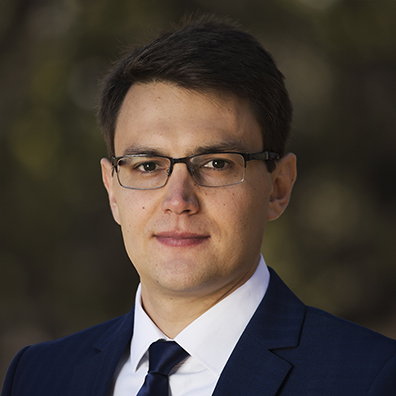
- Assistant Professor, Meyer Early Career Launch Fellow
Biography
Visit Popov Lab
(This link leads to a WSU faculty-maintained lab or research group website. The views and content expressed are those of the faculty member or group and do not represent the official positions or policies of the university.)
Education
- B.S., 2009, M.S., 2011, Physical Chemistry, RUDN University, Russia, Moscow
- Ph.D., 2017, Computational Physical Chemistry, Utah State University, Logan, UT
- Director’s Postdoctoral Fellow, 2017, Los Alamos National Laboratory, Theoretical Division T-1, Physics and Chemistry of Materials, Los Alamos, NM
- Oppenheimer Distinguished Postdoctoral Fellow, 2018-2021, Theoretical Division T-1, Physics and Chemistry of Materials, Los Alamos National Laboratory, Los Alamos, NM
Research
In my group we perform computational modeling of geometric and electronic structures of molecular compounds and gas-phase species, from main group to heavy elements, for applications in energy storage, catalysis, and nuclear separation chemistry. We aim to answer fundamental questions related to the covalency, bonding, reactivity, stability, spectroscopic signatures, and redox properties. In particular, we focus on the following three research areas, wherein we work in close collaboration with world-class experimentalists in order to validate our theoretical predictions and/or characterize their experimental observations from a computational standpoint and rationally design compounds which would exhibit improved characteristics and desired properties.
- Modeling of electronic structures of lanthanide (Ln) and actinide (An) molecular complexes in relation to their chemical, magnetic and spectroscopic properties. We employ DFT and multireference methods to investigate geometric and electronic structures, chemical bonding interactions, redox properties, reactivity, and spectroscopic signatures of Ln and An coordination compounds holding potential for nuclear separation chemistry. Emphasis is placed on the role of f electrons in metal-ligand bonding and quantification of covalency in relation to the reactivity of such complexes. On one hand, we are interested in deciphering the fundamental aspects of the stabilization of highly reactive Ln and An complexes in extremely low oxidation states that could be tuned by the ligand capacity in storing the excess of the electron density at the metal center via back-donation, use of intercalated counterions, and electron withdrawing/donating groups. On the other hand, we aim to rationally design f-block molecular complexes in extremely high oxidation states that could be employed for oxidation-based separations. Our group is particularly interested in deciphering localized and multicenter interactions, covalency of metal-ligand bonding by assessing orbital overlap and energy degeneracy of metal and ligand orbitals, nature of redox events, electron correlation and spin-orbit coupling effects.
- Computational design of charge carriers for redox flow battery applications. Although lithium-ion batteries tend to dominate the headlines, grid-scale energy storage can still be improved by developing alternative technologies. For several decades, the redox flow battery (RFB) has been attractive due to its >4 h of discharge. In contrast to secondary batteries, in which the energy is stored within stationary electrodes, RFBs store and release energy from a redox reaction between soluble chemical species, called redox carriers. Efforts to develop more efficient charge carriers have mostly been empirical, with limited attempts toward the rational design of structural, electronic, and other RFB-relevant properties. In my group, we focus on the computational development of more affordable and efficient RFBs to meet the world’s growing energy storage demands. Understanding the fundamental factors from a molecular level may potentially provide guidance for the next-generation RFBs with higher energy density, stability, solubility, and other RFB relevant characteristics.
- Analysis of the electronic structures of gas-phase and condensed-phase clusters exhibiting unprecedented structures and non-conventional bonding. Understanding how the step-wise addition of atoms leads to the transition from a single atom to a diatomic molecule to an atomic cluster and finally to the formation of bulk solid allotropes represents a fundamental problem. Experimental and theoretical analyses can elucidate the structural and electronic changes that occur during the assembly of individual atoms and how they form atomic clusters and bulk materials of interest. In my group, we are interested in answering fundamental questions, such as why a specific cluster adopts a certain geometry, what makes it stable and how to computationally design clusters with tailored properties. Our research is supported by experimental groups dealing with short-lived clusters observed in a molecular beam through photoelectron spectroscopy experiments as well as with more stable clusters made and characterized in a condensed phase.
Publications
Selected Publications
- K. S. Otte, J. E. Niklas, C. M. Studvick, C. L. Montgomery, A. R. C. Bredar, I. A. Popov*, H. S. La Pierre* “Proton-Coupled Electron Transfer at the Pu5+/4+ Couple” J. Am. Chem. Soc. 2024, 146, 21859–21867.
- J. Niklas, K. Otte, C. M. Studvick, S. R. Chowdhury, B. Vlaisavljevich, J. Bacsa, F. Kleemiss, I. A. Popov*, H. S. La Pierre* “A Tetrahedral Neptunium(V) Complex” Nat. Chem. 2024, 16, 1490–1495.
- A. S. Pozdeev, I. A. Popov* “The Structural and Electronic Split: Boron vs. Aluminum Hydrides” Chem. Phys. Rev. 2024, 5, 011401.
- E. D. Reinhart, C. M. Studvick, A. M. Tondreau, I. A. Popov*, James M. Boncella* “Synthesis and Characterization of Uranium Complexes Supported by Substituted Aryldimethylsilylanilide Ligands” Organometallics 2024, 43, 284–298.
- A. C. Boggiano, C. M. Studvick, A. Steiner, J. Bacsa, I. A. Popov*, H. S. La Pierre* “Structural Distortion by Alkali Metal Cations Modulates the Redox and Electronic Properties of Ce3+ Imidophosphorane Complexes” Chem. Sci. 2023, 14, 11708–11717.
- K. S. Otte, J. E. Niklas, C. M. Studvick, A. C. Boggiano, J. Bacsa, I. A. Popov*, H. S. La Pierre* “Divergent Stabilities of Tetravalent Cerium, Uranium, and Neptunium Imidophosphorane Complexes” Angew. Chem. Int. Ed. 2023, e202306580.
- H.-L. Xu, C. M. Studvick, C. Liu, Y. Xue, I. A. Popov*, Z.-M. Sun “Single-Metal-Encapsulated Double-Cage [Pt@Sn17]4−: An Exception from Group 14 Endohedral Clusters” Chem. Eur. J. 2022, e202202651.
- I. A. Popov, B. S. Billow, S. H. Carpenter, E. R. Batista, J. M. Boncella, A. M. Tondreau, P. Yang “An Allyl Uranium (IV) Sandwich Complex: Are ϕ Bonding Interactions Possible?” Chem. Eur. J. 2022, 28, e202200114.
- Y.-H. Xu, N. V. Tkachenko, I. A. Popov, L. Qiao, A. Muñoz-Castro, A. I. Boldyrev, Z.-M. Sun “Ternary Aromatic and Antiaromatic Clusters Stemmed from a hypho-Zintl Precursor [Sn2Sb5]3-” Nat. Commun. 2021, 12, 4465.
- H.-L. Xu, I. A. Popov, N. V. Tkachenko, Z.-C. Wang, A. Muñoz-Castro, A. I. Boldyrev, Z.-M. Sun “σ-Aromaticity-Induced Stabilization of Heterometallic Supertetrahedral Clusters [Zn6Ge16]4– and [Cd6Ge16]4–” Angew. Chem. Int. Ed. 2020, 59, 17286–17290.
- M. P. Kelley, I. A. Popov, J. Jung, E. R. Batista, P. Yang “δ and φ Back-Donation in AnIV Metallacycles” Nat. Commun. 2020, 11, 1558.
- N. T. Rice, I. A. Popov, D. R. Russo, J. Bacsa, E. R. Batista, P. Yang, J. Telser, H. S. La Pierre “Design, Isolation, and Spectroscopic Analysis of a Tetravalent Terbium Complex” J. Am. Chem. Soc. 2019, 141, 13222–13233.
- X. Dong, A. R. Oganov, A. F. Goncharov, E. Stavrou, S. Lobanov, G. Saleh, G.-R. Qian, Q. Zhu, C. Gatti, V. L. Deringer, R. Dronskowski, X.-F. Zhou, V. B. Prakapenka, Z. Konôpková, I. A. Popov, A. I. Boldyrev, H.-T. Wang “A Stable Compound of Helium and Sodium at High Pressure” Nat. Chem. 2017, 9, 440–445.
- I. A. Popov, F.-X. Pan, X.-R. You, L.-J. Li, E. Matito, C. Liu, H.-J. Zhai, Z.-M. Sun, A. I. Boldyrev “Peculiar All-Metal σ-Aromaticity of [Au2Sb16]4− Anion in the Solid State” Angew. Chem. Int. Ed. 2016, 55, 15344–15346.
- I. A. Popov, T. Jian, G. V. Lopez, A. I. Boldyrev, L.-S. Wang “Cobalt-Centred Boron Molecular Drums with the Highest Coordination Number in the CoB16– Cluster” Nat. Commun. 2015, 6, 8654.