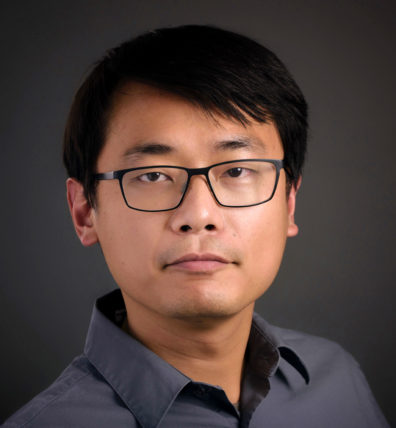
- Associate Professor, Department of Chemistry
Biography
Visit Guo Lab
(This link leads to a WSU faculty-maintained lab or research group website. The views and content expressed are those of the faculty member or group and do not represent the official positions or policies of the university.)
Education
Seaborg Postdoctoral Fellow, 2015-2017
Los Alamos National Laboratory, Los Alamos, NM
Ph.D. Chemistry, 2010-2014
University of California, Davis, CA
B.S. Physics, 2006-2010
Sun Yat-sen University, Guangzhou, China
Research
Dr. Xiaofeng Guo received his Ph.D. in Chemistry from the University of California, Davis in 2014 under the supervision of Professor Alexandra Navrotsky. He continued the postdoctoral research with Dr. Hongwu Xu at the Los Alamos National Laboratory as a Seaborg Postdoctoral Fellow.
He joined WSU in 2018, received the NSF CAREER award in 2022, and Early-Career and Emerging Researchers in Physical Chemistry (JPCC) in 2023.
The focus of his research is studying the structures and thermodynamics of f-block condensed matter.
In Guo’s lab, we study lanthanides and actinides containing materials and minerals by probing their structural changes and energetic landscapes under (extreme) conditions, via synchrotron X-ray and neutron scattering, X-ray spectroscopy, ultrasonic spectroscopy, data-driven analysis, and advanced calorimetry.
We are interested in the following research areas:
- Actinide thermochemistry (transuranium labs for U, Th, Pu, etc.)
- Rare Earth Elements (REE) and actinide ceramics
- Geochemistry of REE and actinide (nano)minerals
- Materials under extremes (high-temperature, high-pressure, and hydrothermal conditions)
- Molten salt thermochemistry (Calvet calorimetry on heat of mixing and heat capacity)
- Nuclear fuel research (nanosized oxides, MOX, U-Si, U-C, U-N fuels)
- Nuclear ceramic-based wastes (silicates and phosphates)
Students in the group will be trained in inorganic synthesis; X-ray and neutron-based characterizations (X-ray and neutron scattering, PDF, XAS, XRF); high pressure (diamond anvil cell); ultrasonic resonant spectroscopy, and thermal analysis techniques (DSC, TGA, high temperature calorimetry).
Selected Publications
- Strzelecki, A., Migdisov A.A., Boukhalfa, H., Sauer, K., McIntosh, K.G., Currier, R.P., Williams-Jones, A.E., Guo, X., Fluocertie as a Precursor to Rare Earth Element Fractionation in Ore-forming Systems, Nature Geoscience 15, 327-333, 2022.
- Cui, M., Yang, C., Hwang, S., Yang, M., Overa, S., Dong, Q., Yao, Y., Brozena, A.H., Cullen, D.A., Chi, M., Blum, T.F., Morris, D., Finfrock, Z., Wang, X., Zhang, P., Goncharov, V., Guo, X., Luo, J., Mo, Y., Jiao, F., Hu, L., Multi-principal Elemental Intermetallic Nanoparticles Synthesized via a Disorder-to-Order Transition, Science Advances 8 (4), eabm4322, 2022.
- Marcial, J., Zhang, Y., Zhao, X., Xu, H., Mesbah, A., Nienhuis, E.T., Szenknect, S., Neuefeind, J.C., Lin, J., Qi, L., Migdisov, A.A., Ewing, R.C., McCloy, J.S., Dacheux, N., Guo, X., Thermodynamic Non-ideality and Disorder Heterogeneity in Actinide Silicate Solid Solutions, npj Mater. Degrad. 5, 34, 2021.
- Strzelecki, A., Barral, T., Estevenon, P., Mesbah, A., Goncharov, V., Baker, J., Bai, J., Clavier, N., Szenknect, S., Migdisov, A.A., Xu, H., Ewing, R.C., Dacheux, N., Guo, X., Role of Water and Hydroxyl Groups in the Structures of Stetindite and Coffinite, MSiO4 (M = Ce, U), Inorg. Chem. 60(2), 718-735, 2021.
- Goncharov, V., Wei, N., Lau, A., Emnaceur, S.M., Migliori, A., Xu, H., Long, M., Guo, X., Elastic and Thermodynamics Properties of Cerium Doped Yttrium Aluminum Garnets, J. Am. Ceram. Soc 104(7), 3478-3496, 2021.
- Strzelecki, A., Kriegsman, K., Estevenon, P., Goncharov, V., Bai, J., Szenknect, S., Mesbah, A., Wu, D., McCloy, J.S., Dacheux, N., Guo, X., High Temperature Thermodynamics of Cerium Silicates, A-Ce2Si2O7 and Ce4.67(SiO4)3O, ACS Earth and Space Chem. 4(11), 2129-2143, 2020.
- Prieur, D., Bonani, W., Popa, K., Walter, O., Kriegsman, K.W., Engelhard, M.H., Guo, X., Eloirdi, R., Gouder, T., Beck, A., Vitova, T., Scheinost, A.C., Kvashnina, K., Martin, P., Size Dependence of Lattice Parameter and Electronic Structure in CeO2 Nanoparticles, Inorg. Chem., 59(8), 5760-5767, 2020.
- Olds, T.A., Karcher, S.E., Kriegsman, K.W., Guo, X., McCloy, J.S., Oxidation and Anion Lattice Defect Signatures of Hypostoichiometric Lanthanide-doped UO2, J. Nucl. Mater., 530, 151959, 2020.
- Guo, X., Lü, X., White, J.T., Benmore, C.J., Nelson, A.T., Roback, R., Xu, H., Bulk Moduli and High Pressure Crystal Structure of U3Si2, J. Nucl. Mater., 523, 135-142, 2019.
- Migdisov, A.A., Guo, X., Nisbet, H., Xu, H., and Williams-Jones, A.E., Fractionation of REE, U, and Th in Natural Ore-forming Hydrothermal Systems: Thermodynamic Modeling, J. Chem. Thermo., 128, 305-319, 2019.